Scaling to AI-Native: The 2026 Roadmap
- Amarjit S.
Most organizations are stuck in "AI Theater"—running small, isolated pilots that fail to scale because they are bolted onto old, manual processes.
In 2026, you'll need to move from "AI-Enabled" to "AI-Native." This involves a fundamental shift in how your business operates, moving away from simple chatbots toward Agentic Workflows—AI systems that can execute entire business processes from start to finish.
In this article, I've shared a clear 3-point framework to:
Transition from informational tools to autonomous agents.
Identify and eliminate the "silent costs" that stall your ROI.
Build a "Digital Brain" (Knowledge Base) that serves as the foundation for growth.
In 2025, companies "dabbled" in AI. most companies were just "testing the waters"—maybe using it to write an email or summarize a meeting. That’s what I noticed. In 2026, the market is separating the pretenders from the transformers.
Everyone wants to scale, but to scale, one must move from "bolting AI onto old processes" to building an AI-Native foundation. The real winners are moving from just "using tools" to building AI-Native businesses. Ok! That's a whole lot of "natives" :-)

Forget about “Code” think about “Workflows”
You will need to re-engineer how your data flows in your organization.
You need to make sure your AI ‘genius’ bot that you have created or planning to create, isn’t going to be just another chat assistant sitting on the sidelines, but rather, make it become a core part of how your "digital nervous system" actually functions.
Imagine you have a bucket with a small hole in it. Most companies are trying to solve this by pouring more water (more AI tools) into the bucket.

AI-Native Scaling is about fixing the hole in the bucket first by redesigning how your data flows, so that when you add AI, nothing goes to waste. AI can take on a lot more than you and I can imagine. Think about it.
The "Pilot Paradox": Why Most AI Projects Stall
Last year, I spoke with dozens of C-suite managers in a conference who all said the same thing,
"Our AI pilot was amazing, but we can't seem to get it to move the needle on the actual balance sheet."
This is the Pilot Paradox. A pilot project is like putting a Ferrari engine into a horse-drawn carriage. The engine is powerful, but the wooden wheels (your legacy processes) can’t handle the speed.
In 2026, scaling isn't a technical challenge; it’s an operational redesign.
1. Moving from "Chatbots" to "Agentic Workflows"
The biggest change this year is the rise of Agentic AI.
Old Way (2024-25)
A customer asks a chatbot for their order status. The bot says, "Your order is in transit." (Informational)New Way (2026)
An AI Agent sees the order is delayed, checks the warehouse API, realizes the item is out of stock, offers the customer a 20% discount or an alternative product, and updates the CRM—all without a human clicking a single button. (Operational)
Here’s another neat example:
Think of your favourite local coffee shop.
The "Chatbot" is the sign outside telling you the prices. The "Agent" is the barista who remembers your name, suggests a muffin because they know you’re usually hungry at 9 AM, and processes the payment.
If you noticed the feature image of this article, the illustration was created using AI Banana Nano and it took me less than 20-seconds to do it. Do you know of anyone who could generate such detail and crisp clarity in seconds? Something to ponder upon.
2. Solving the "Silent Costs" of Middle Management
Scale is often throttled by what I call "The Middle Management Squeeze." As AI generates more data and faster outputs, human managers often become the bottleneck, spending 40% of their day just "checking" AI work or moving data between systems.
To scale, you must identify your ‘heaviest bottleneck’.
Example: If your marketing team uses AI to write 50 blogs a week, but your legal team takes 10 days to review each one, you haven't scaled—you've just created a bigger pile of unread drafts.
The Fix: You need a Governance Framework (something we dive deep into the AI Executive Playbook) that allows the AI to operate within "safe zones" so humans only intervene on high-risk exceptions.
3. The Foundation: Your "Digital Brain" (The Knowledge Base)
You cannot scale AI if your data is a mess. In 2026, your Knowledge Base (KB) is your most valuable employee.
If your KB is just a collection of dusty PDFs, your AI will hallucinate. An AI-Native company treats its KB as a "living organism."
Let me explain further. A global logistics firm a friend of mine worked for recently stopped "training" their staff on new regulations. Instead, they updated their central Knowledge Base.
Their AI agents instantly "learned" the new rules and began applying them to customs forms across three continents within minutes. Now, that's what I call the power of scaling is all about.
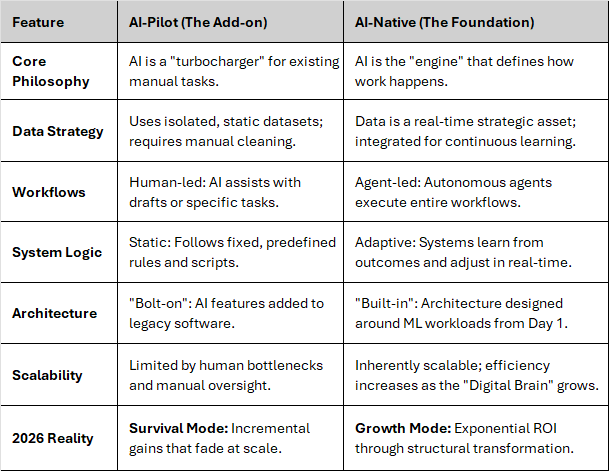
Ai-Pilot versus Ai-Native Comparison
TIP: If you want to understand what a knowledge bases (KB) is, check out this 1-min video:

Executive Checklist
Is your business ready to scale? To move towards an AI-Native model this month, ask your team these 3-questions:
The Integration Check
Does your AI have "read/write" access to our core systems, or is it just a glorified search bar?The Bottleneck Check
Where is the "human-in-the-loop" actually causing a "human-in-the-way" delay?The Data Check
If we hired 100 new humans today, is our documentation clear enough for them to work without asking questions? If not, your AI won't work either.
Final Thoughts
Scaling AI isn't about buying more tools; it's about orchestrating them. If you’re still stuck in the "experimentation" phase, you’re losing ground to competitors who are already rewriting their workflows.
Ready to stop "piloting" and start "producing"?
In my AI Executive Playbook course, we spend Week 1 conducting a "Mini-Audit" of your company’s silent costs to find exactly where AI will give you the fastest ROI.
Common Questions
Q: What is an AI-Native business model?
A: It’s a model where operations, strategy, and culture are designed around AI’s capabilities (speed, scale, data processing) rather than fitting AI into old manual workflows.
Q: Why do 95% of AI pilots fail?
A: According to MIT research, most fail because they are "bolted on" to legacy models, which simply scales existing bottlenecks rather than solving them.
Q: How do I start scaling AI in my company?
A: Start by identifying the single biggest constraint in your workflow—usually a high-volume, repetitive task—and build an agentic workflow to handle it from end to end.
W3 Circle Mailer
Subscribe FREE & be the first to receive latest industry info, recently published articles, online courses, project discussions, invite to 'members-only' meetups, discounted exam vouchers, etc.