Agentic Workflows: From Prompts to Processes
- Amarjit S.
If your current AI strategy relies on your team writing manual, one-off prompts, you aren’t scaling; you’re just "chatting". To achieve a truly AI-Native operation, you must move beyond the typewriter :-) and begin architecting autonomous systems that orchestrate tasks without constant hand-holding.
This transition requires a shift in mindset: you are no longer a writer of prompts, but a manager of a digital workforce. Here is how we build that architecture.

Step 1: Grounding Your Strategy
Imagine a mid-sized Marketing Agency that wants to automate its client onboarding process using AI agents.
The Traditional Problem : The "Hallucination" Risk
Without a grounded strategy, if an employee asks an AI to "write an onboarding email for a new client," the AI might "guess" the pricing, invent a project timeline, or use a tone that doesn't match the brand. This is a "hallucination" caused by a lack of specific context.
The Strategic Implementation
Instead of letting the AI guess, the organization takes the following steps to prepare its data:
SOPs: They export all "Client Kick-off" procedures into a structured format.
Brand Guidelines: They upload their 2026 Voice & Tone guide, ensuring the AI knows whether to be "Corporate" or "Edgy".
Past Performance: They pull anonymized data from previous successful projects to act as benchmarks for realistic timelines.
We don't provide past data so the AI can live in the past; we provide it so the AI can accurately predict the future. It transforms the agent from a generic assistant into a partner that understands your firm’s specific velocity and capacity.
The Operational Result: Data Integrity
When the AI agent starts a task, it doesn't just "guess"; it performs a semantic search across these specific files first to find the exact rule or guideline. By following the NIST AI Risk Management Framework, it ensures:
Accuracy
The AI is "grounded" in real documents, meaning it only provides information that actually exists in the agency's files.Reliability
Because the database is the only source of truth, the agent's output remains consistent across different clients.Security
Sensitive past performance data is handled according to global privacy standards before the AI ever "reads" it.
Step 2: Implementing HITL Governance (Bespoke)
Imagine a Corporate Training Firm that uses AI agents to generate personalized, high-level training modules for international clients.
What's The Situation?
The firm has deployed a specialized agent that accesses their internal database of proprietary methodologies and case studies to research and generate a full 5-page training module without direct human intervention.
What's The Risk?
While the agent is grounded in correct data and rarely "hallucinates," it sometimes lacks the nuanced understanding of a specific client's corporate culture. It might pick an outdated case study that technically fits the prompt but is no longer strategically relevant for that specific executive team. Sending this directly to the client could damage the firm's reputation for high-quality, bespoke content.
The HITL Implementation & Mandatory Review Node
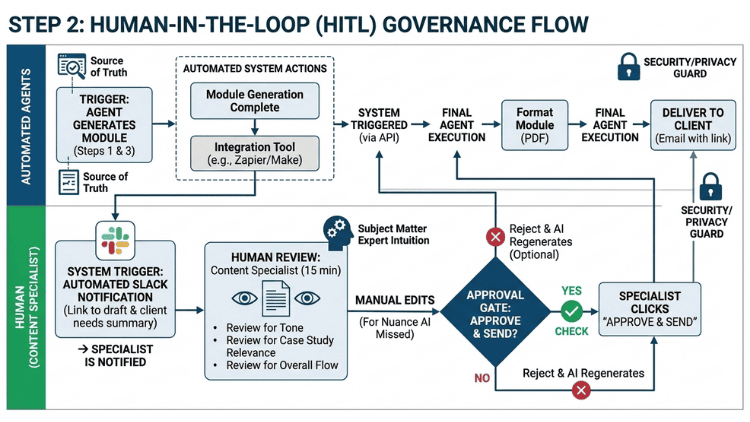
Think of this HITL (Human-in-the-Loop) flow as a "Digital Assembly Line" with a human quality controller at the end. Instead of letting an AI agent "run wild" and send documents directly to your clients, we build a safety gate.
Instead of allowing the agent to email the module directly, the firm architects a "Human-in-the-Loop" checkpoint:
How does this work, exactly?
1. The Automated Start (The "Heavy Lifting")
The process begins with the AI agent doing the grunt work—gathering data and drafting the module. Once the draft is finished, an integration tool (like Zapier or Make) acts as a digital courier. It picks up that draft and sends a notification to a human teammate on Slack.
2. The Human Checkpoint (The "Nuance" Phase)
This is where the "Newbie" or a Specialist steps in. You receive the Slack message with a link to the draft. Your job isn't to rewrite the whole thing, but to spend about 15 minutes checking for the "human touch"—things like:
Does the tone sound right for this specific client?
Is the case study actually relevant to their industry?
Are there any "weird" AI phrases that need a quick fix?
3. The Approval Gate (The "Safety Switch")
The AI is "locked" and cannot send the email until you click a specific "Approve & Send" button.
If you approve: The system automatically converts the file to a professional PDF and emails it to the client.
If you reject: The system can be told to "try again" or send it back for more edits.
The Bottom Line Is...
This process ensures the AI handles the speed, but the human handles the standards. It’s the ultimate way to scale your work without ever worrying about a "robot" making a public mistake.
Step 3: Deploying Specialized Micro-Agents
Imagine a Regional Sales Director who needs to stay updated on competitor pricing and new product launches across Southeast Asia.
The Situation: The "God-Model" Trap Many firms try to build one "all-in-one" AI to handle their entire Sales and Marketing department. These massive models often become unstable, hallucinate, and are nearly impossible to troubleshoot when they fail.
The Implementation: The Micro-Agent Library Instead of one giant system, the firm deploys three narrow, specialized "Micro-Agents" that follow a clear, repeatable logic:
The "Scout" Agent: Its only job is to monitor five specific competitor websites daily for pricing changes.
The "Summarizer" Agent: It takes the raw data from the Scout and extracts only the three most relevant "threats" based on the firm’s current inventory.
The "Drafting" Agent: It takes those threats and writes a 3-sentence internal brief for the Sales team to use in negotiations.
The Operational Result: Scalable, Low-Risk ROI By focusing on these "modular" units, the firm achieves immediate stability:
Stability: If the competitor changes their website layout, only the "Scout" agent needs a 5-minute fix; the rest of the system keeps running.
Proven ROI: The Director sees a "small win" immediately—the Sales team is more informed without a massive upfront investment in custom software.
No Disruption: Because these agents are narrow and specialized, they can be integrated into the workflow without risking a large-scale collapse of departmental operations.
Step 4: Architecting System Connectivity
Imagine a Regional Sales Team that spends 10 hours a week manually copying lead data from emails into their CRM and setting follow-up tasks in their project management tool.
The Situation: The "Manual Copy-Paste" Bottleneck Most companies treat AI like a calculator—they paste a question in, get an answer, and then manually paste that answer somewhere else. This "manual data entry" is a high-cost, low-value activity that leads to human error and employee burnout.
The Implementation: API-Driven Connectivity Instead of a standalone chatbot, the firm uses integration platforms (like Zapier or Make) to connect their AI agents directly to their software stack via RESTful APIs:
CRM Link: When a new lead email arrives, the AI agent "reads" it and automatically creates a new contact record in the CRM.
Project Management Sync: The agent then cross-references the client’s industry with the team’s current capacity and creates a "Kick-off" task in the project management tool.
Automated Data Flow: The information moves seamlessly between platforms without a single human click.
The Operational Result: Unlocked Enterprise Value By shifting from "prompts" to "integrated processes," the firm achieves true systemic efficiency:
Elimination of Busywork: You remove the need for human data entry, ensuring that 100% of your data is captured accurately and instantly.
Strategic Reallocation: Your team is freed from the "copy-paste" trap, allowing them to focus on high-value work like closing deals and building client relationships.
System Maturity: Your AI has evolved from a text-generator into a functioning component of your digital infrastructure.
Step 5: Orchestrating the Digital Workforce
Imagine a Boutique Investment Firm that wants to produce a weekly "Market Sentiment Report" for its high-net-worth clients, a process that usually takes a team of analysts three days to complete.
The Situation: The Silo Problem The firm already has the Micro-Agents from Step 3 and the Connectivity from Step 4. However, a human still has to manually trigger the "Scout" agent, wait for the result, then trigger the "Summarizer" agent, and so on. The process is faster, but it still requires constant human "babysitting" to move the ball from one station to the next.
The Implementation: The "Manager Agent" Layer The firm introduces an Orchestration Layer—a "Manager Agent" whose only job is to oversee the goal:
Goal Assignment: The executive gives one high-level command: "Generate the Weekly Sentiment Report for the Tech Sector."
Task Delegation: The Manager Agent autonomously breaks this goal into technical tasks. it commands the Scout Agent to gather data, passes that data to the Analyst Agent for comparison, and sends the final draft to the HITL Review Node (from Step 2).
Conflict Resolution: If the Scout Agent fails to find data on a specific competitor, the Manager Agent doesn't just stop; it "thinks" and assigns an alternative task to search a different database.
The Operational Result: End-to-End Scaling By architecting this final layer of orchestration, the firm achieves true operational scale:
Minimal Oversight: You are no longer managing individual tasks; you are managing a coherent workforce that understands your high-level goals.
24/7 Productivity: The system can coordinate these end-to-end workflows overnight, presenting a "Ready for Review" report to the executive's inbox by 8:00 AM.
Elastic Growth: As your business grows, you don't necessarily need more humans for the heavy lifting; you simply add more specialized Micro-Agents to your Manager’s toolkit.
Interesting article by McKinsey: Why Agentic AI is the Next Big Thing
As you build this digital infrastructure, ensuring it aligns with global standards like ISO/IEC 42001 for AI management will be the key to long-term trust and scalability. The question for 2026 is no longer whether AI can do the work, but how effectively you have architected the system that manages it.
Moving from prompts to processes is the ultimate step in your AI maturity journey. By architecting these five layers, you transition from a reactive user to a proactive architect of business value. It is time to stop chatting and start building.
If you're keen, join me in the next intake where I share with leaders, C-suites, and students how each layer works and how to intertwine all the layers aligned cohesively with your organization's end goals.
W3 Circle Mailer
Subscribe FREE & be the first to receive latest industry info, recently published articles, online courses, project discussions, invite to 'members-only' meetups, discounted exam vouchers, etc.